The naming problem has not changed. The tools have.
Every founder faces the same wall: the obvious names are taken, the clever ones sound wrong out loud, and the available ones feel like compromises. For decades the only way through was a whiteboard, a thesaurus, and stubbornness.
Now AI domain name generators promise hundreds of brandable ideas in seconds. Are they actually better than brainstorming by hand — or just faster at producing mediocrity? After looking closely at both approaches, the honest answer is: it depends on what you ask each of them to do.
How AI name generators work in 2026
A modern AI domain name generator takes a description of your business — what you do, who it is for, the feeling you want — and produces name candidates using language patterns it has learned from millions of existing brands. The good ones then check domain availability automatically, so you only see names you can actually register.
The key shift from earlier generations of these tools is context. Old generators just smashed keywords together ("BestTechSolutions"). Current AI tools understand tone, industry conventions, and naming styles — playful, premium, technical, minimal — and can iterate: you react to suggestions, and the tool refines toward what you like.
What they cannot do is want something. An AI has no taste, no gut feeling, and no understanding of your specific vision beyond what you type. That limitation shapes everything about when AI helps and when it does not.
Where AI wins
- Volume and speed. A human brainstorms maybe thirty names in an hour before fatigue sets in. AI produces hundreds in seconds without getting tired or anchored to its first idea.
- Breaking fixation. Humans fixate — on the first decent idea, on a competitor's style, on a word they love. AI has no attachment to any suggestion, so it explores corners of the possibility space you would never wander into.
- Availability-first results. The most demoralizing part of manual brainstorming is falling in love with a name, then discovering the .com is taken. AI generators that check availability as they go eliminate that cycle entirely.
- Pattern fluency. AI has effectively read every startup name ever registered. It knows which syllable combinations sound like a fintech and which sound like a skincare brand — and it applies those patterns instantly.
- Iteration without ego. Telling a colleague their idea is bad has social cost. Rejecting fifty AI suggestions costs nothing, which makes the feedback loop brutally honest and fast.
Where humans still win
- Meaning and story. The best brand names carry a story — a founder's inside joke, a meaningful reference, a word from another language that matters to the team. AI can imitate meaning; it cannot originate yours.
- Cultural judgment. AI does not know that your clever name is slang for something unfortunate in your second-biggest market, or that it sounds like a competitor's product when said aloud. Humans catch what pattern-matching misses.
- Strategic naming. Should the name describe what you do, or be an empty vessel you fill with meaning? Should it work in three languages? These are strategy questions, and strategy is still a human job.
- The final call. Naming is ultimately an act of conviction — choosing one name and committing years of work to it. No tool can make that commitment for you, and outsourcing the decision usually produces names nobody loves.
The hybrid workflow that beats both
The founders who name best in 2026 do not choose a side. They run a hybrid process, and it looks like this:
Step 1 — Brief yourself first. Before touching any tool, write down what the brand should feel like, who it is for, and any words or stories that matter. This is the human strategy work, and it takes twenty minutes.
Step 2 — Generate with AI. Feed that brief into an AI domain name generator and produce a large candidate pool. Do not judge yet — collect.
Step 3 — Filter by hand. Read the list aloud. Kill anything hard to say, hard to spell, or hard to remember. This is where human judgment earns its keep.
Step 4 — Check availability properly. Run survivors through bulk domain search and all-TLD search to see what is actually registrable and which extension fits best.
Step 5 — Sleep on the shortlist. The name that still feels right in the morning is usually the one. AI gives you options; time gives you conviction.
The naming checklist
Whatever method produces your shortlist, run every finalist through these tests:
- Short. Aim for under ten characters if you can. Every extra syllable is friction in conversation and typing.
- Sayable. Say it out loud five times. Then imagine saying it on a noisy phone call. If you have to spell it, it fails.
- Spellable. The radio test: if someone hears the name once, can they type it correctly? Avoid unusual spellings, doubled letters, and ambiguous sounds.
- Memorable. Distinctive beats descriptive. A name people remember imperfectly but distinctively outperforms one they forget completely.
- Trademark-screened. Search trademark databases in your market before you commit. An available domain with a conflicting trademark is a lawsuit waiting to happen, not a brand.
- Extension-appropriate. The right extension reinforces the brand — .ai for AI products, .io for developer tools, .com for broad consumer plays. Check what is available, not just what is traditional.
- Future-proof. Do not name yourself into a corner. A name tied to one product or one trend becomes baggage the day you expand.
So which is better?
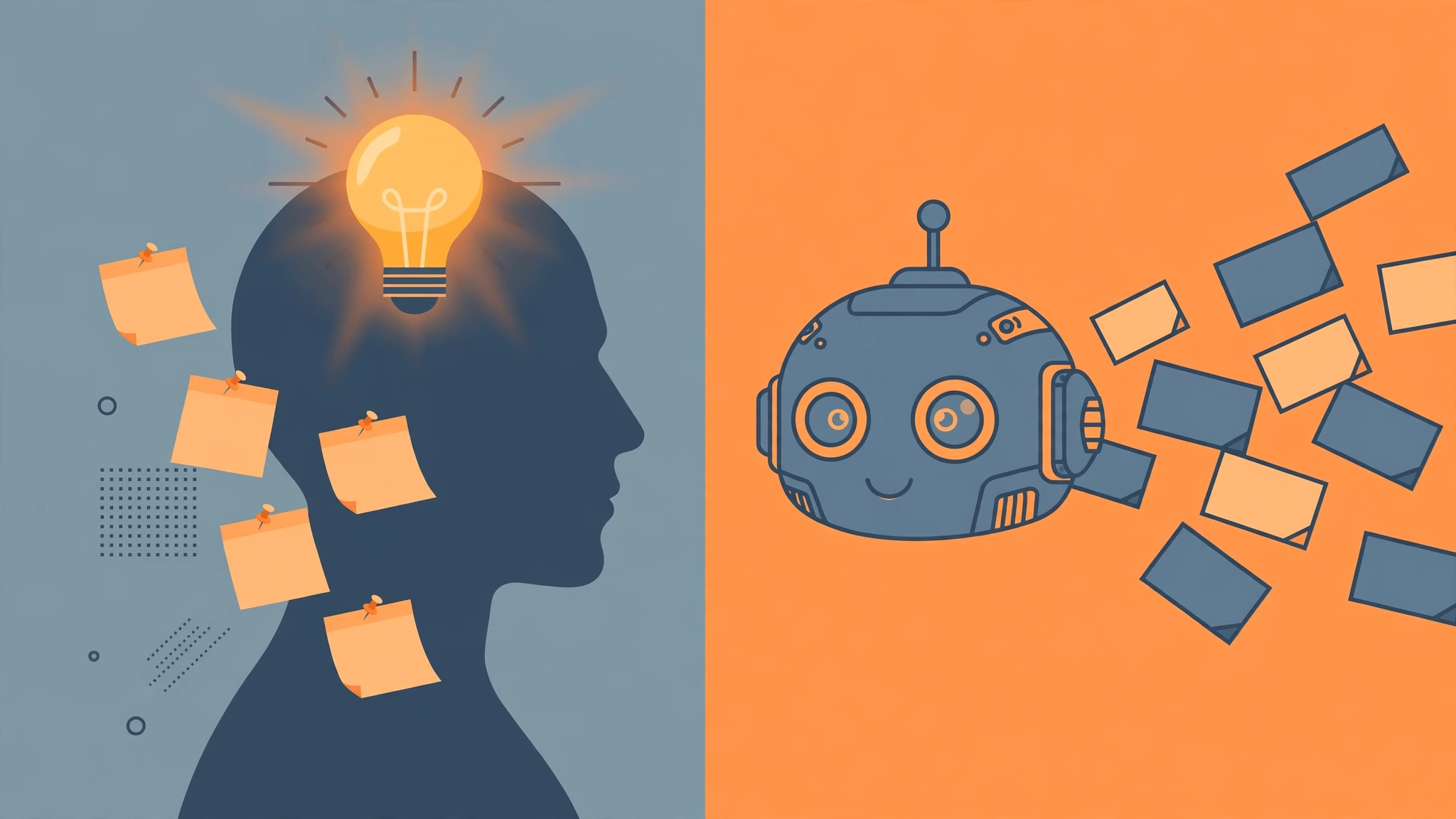
AI is the better generator: faster, broader, tireless, and honest about availability. Humans are the better judges: strategic, cultural, and capable of conviction. The question was never which one wins — it is which job you give each.
Use AI for what it is good at: producing a wide, available, on-brief candidate pool in minutes. Keep the human work for yourself: the brief, the filtering, the cultural checks, and the final choice. That combination consistently beats either approach alone.
Try the hybrid workflow now: generate your candidate pool with Nomlen's free AI domain name generator, or talk it through with AI Domain GPT — then run your shortlist through bulk availability search and pick your winner with confidence.