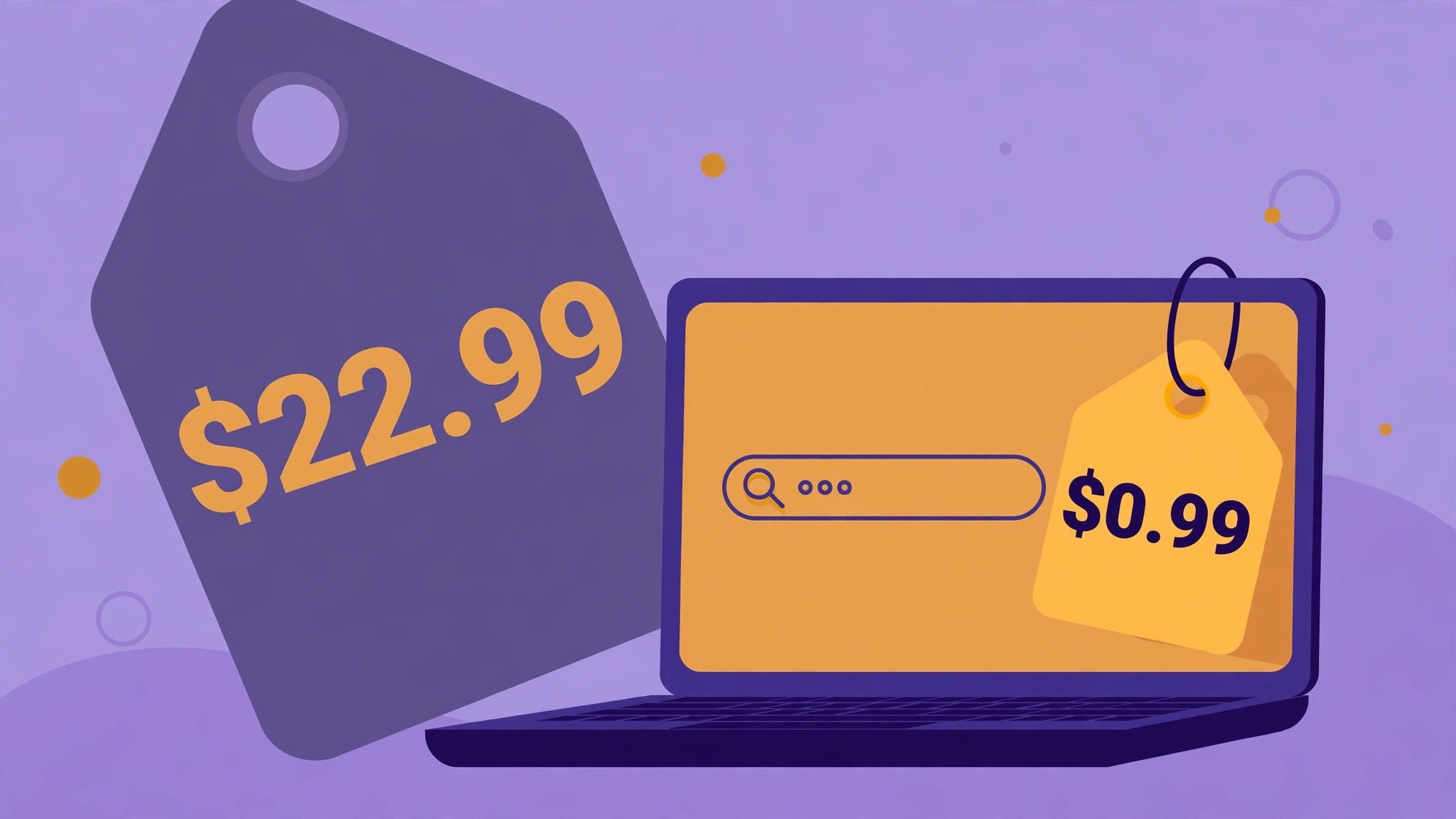
The $0.99 price tag is only the beginning
You found the perfect domain. The checkout page says $0.99 for the first year. It feels like a steal, so you register it and move on with your day.
Twelve months later, the renewal notice arrives: $22.99. The year after that, the same. By year five, that "cheap" domain has quietly cost you close to a hundred dollars — and switching registrars mid-project feels like too much hassle to bother.
This is the renewal trap, and it is the single most common pricing surprise in the domain industry. Once you understand how it works, it is easy to avoid. Let us walk through it.
How first-year promo pricing actually works
Most large registrars sell first-year registrations below cost. They can afford to lose money on year one because they know most customers will renew for years — and the renewal price is where the profit is made.
Nothing about this is hidden in a legal sense. The renewal price is usually printed on the checkout page in small text, or one click away on a pricing page. But almost nobody clicks. The big "$0.99" number does all the talking.
The result: two registrars can sell you the exact same .com, and one can cost you twice as much over five years. The difference is not the product. The product is identical — a domain is a domain, no matter who sells it. The difference is purely the pricing structure.
A worked example: the 5-year cost of a $0.99 domain
Here is an illustrative example based on typical pricing patterns in the industry. The numbers below are rounded examples, not quotes from any specific registrar — but the math is exactly how the trap works.
Registrar A (promo-led pricing): $0.99 for year one, then $22.99 per year to renew.
- Year 1: $0.99
- Years 2–5: 4 × $22.99 = $91.96
- 5-year total: $92.95
Registrar B (flat pricing): $15.99 every year, no promos, no surprises.
- Years 1–5: 5 × $15.99 = $79.95
The "$0.99" domain ends up costing about $13 more than the registrar that looked more expensive on day one. Stretch that to ten years or a portfolio of five domains, and the gap grows into hundreds of dollars.
This is why experienced domain buyers ignore the headline price and compare the total cost of ownership instead.
Why renewals are priced so much higher
Every domain has a wholesale cost — the fee the registrar pays to the registry that operates the extension. For a .com, that wholesale fee is roughly the same for every registrar. Nobody can sell renewals below that floor forever.
First-year promos are marketing spend. The registrar eats the loss to win you as a customer. Renewal pricing is where they recover it, which is why the gap between "register" and "renew" prices is the most honest signal of a registrar's pricing philosophy.
Some registrars keep register and renew prices close together and make their margin on volume. Others run deep first-year discounts and steep renewals. Neither model is dishonest — but only one of them is cheap in the long run.
5 things to check before you register any domain
Before you type in your card details, check these five things. It takes two minutes and can save you real money.
- 1. The renewal price, not the promo price. This is the number you will actually pay for the life of the domain. If it is hard to find, that tells you something.
- 2. The transfer price. If renewals turn out to be painful, you can move your domain to a cheaper registrar. Check what a transfer costs — it usually includes a one-year renewal — and confirm there is no transfer-out fee.
- 3. WHOIS privacy cost. Some registrars charge extra every year to keep your personal details out of the public WHOIS database. Others include it free. Over five years, a $10/year privacy add-on adds $50 to your bill.
- 4. Multi-year registration discounts. Registering for 2, 3, or 5 years up front can lock in today's pricing and protect you from future price rises. Do the math on whether the discount beats a cheaper registrar's annual price.
- 5. The promo fine print. Some "$0.99" offers apply only to specific extensions, require bundled hosting, or exclude renewals entirely. Read the two lines of small print before you celebrate.
Compare total cost, not the headline price
The renewal trap works because shoppers compare first-year prices. Smart buyers compare the 5-year total: first year + four renewals + privacy + any transfer fees.
Nomlen's TLD price list shows register, renew, and transfer prices side by side across extensions and registrars, so you can spot the traps before you buy. Prices change often, so always confirm the live numbers at checkout — but starting from the full picture puts you ahead of nearly every buyer.
The cheapest domain is rarely the one with the lowest first-year price. It is the one with the lowest price in year two, three, four, and five. Now you know how to find it.
Ready to buy without the trap? Run your name idea through Nomlen's live TLD price comparison to see the true register, renew, and transfer cost across registrars — then register with confidence.